Well, well, well... it's only the most important choice you will be making — that is, after finding someone you want to marry, what career you want to pursue, where you live or go to school and the many other decisions we have to make.
Step I — Build your mood board
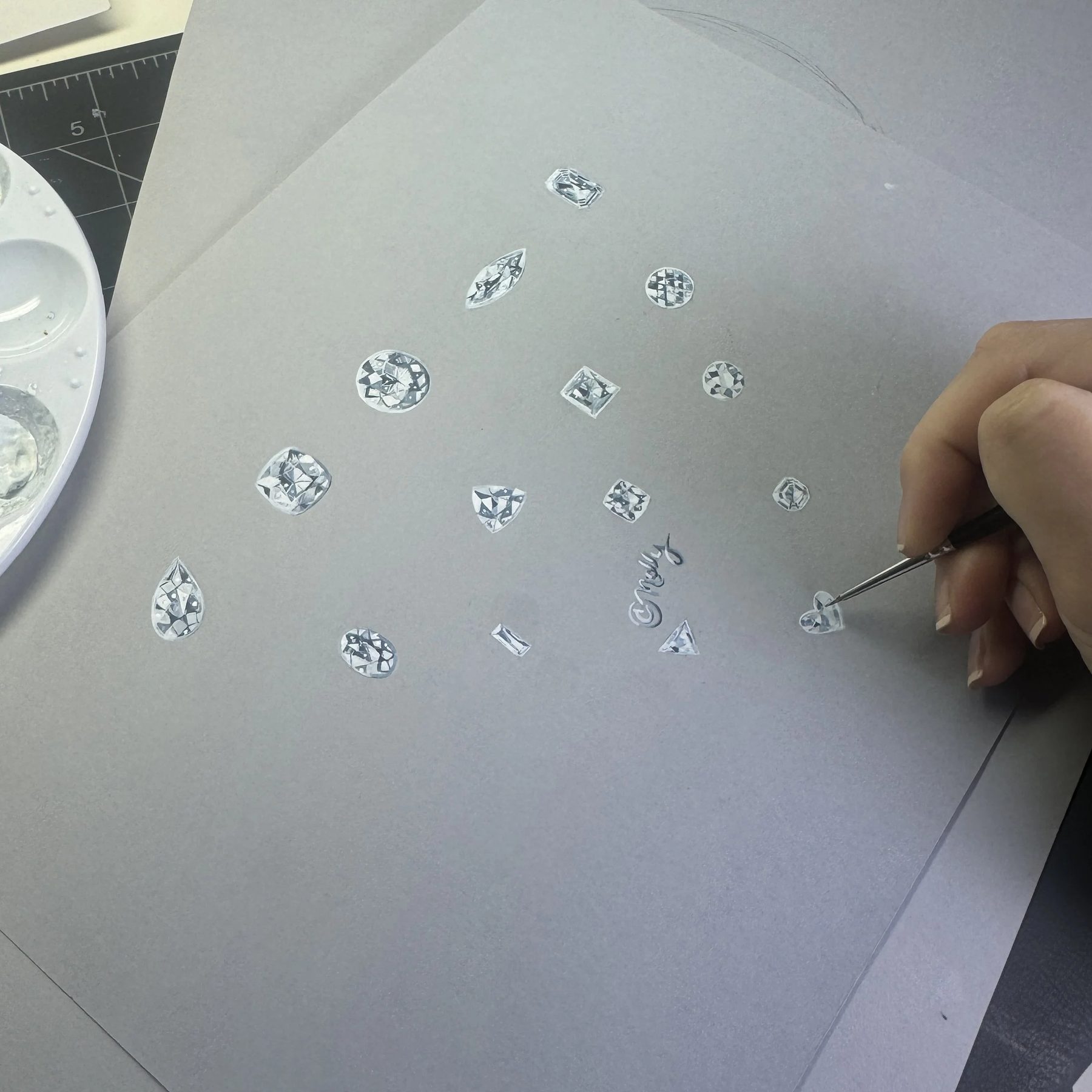
When looking at rings, like any other big purchase, I recommend having a mood board. Almost like a vision board except for your ring — put anything that inspires you on it, starting with other rings you have seen on the internet or in stores. Find the details you like: maybe you love a pavé hidden halo, or a three stone ring. What stone shapes call your attention? Do you even want a diamond?
There are so many stone shapes to choose from: emerald cut, a traditional round brilliant, an old mine cushion cut, a cushion cut, a pear shape, an oval shape, a marquise shape, a rose cut — and the list goes on. There is no right or wrong; it's just about what you prefer.
Consider your lifestyle as well. I highly encourage you to take the ring off for any heavy-duty activities, such as working out — but you still want to account for what type of jewelry wearer you are. I work with my hands a lot and like to keep my jewelry on, so I need a diamond for the type of lifestyle I lead.
Step II — Learn the 4 C's
Become familiar with what the 4 C's are: Carat, Clarity, Color, Cut.
Carat: refers to the actual weight of the diamond. This term comes from Carob seeds, which were used as a weighing instrument. Today: .2 grams = 1 carat.
Clarity: Evaluates any internal flaws, inclusions, and external imperfections — graded from Flawless (F) all the way to Included (I-3).
Color: Colorless is the absence of color (D color) all the way down to Z, which is more on the faint yellow, brown or gray scale. Most people cannot tell the difference between a D and an E without extensive Diamond Grading experience.
Cut: About proportions, symmetry and polish. An excellent cut diamond will sparkle far more than a poor cut, even if the other 3 C's are slightly better.
Step III — Figure out your budget
I didn't start with this first because you can be more creative with your money if you see what's available first and then narrow down your choices. Your budget will go further if you know what you are looking for and are willing to put in the work and do the research.
After determining the budget, you may realize you are willing to compromise on size but not on clarity — or you'd rather get a larger diamond with a slight hint of yellow. This is where knowledge of the four C's helps.
Step IV — Find someone reputable to make it
Come ready with inspiration images and any details you do not want to miss out on. Pick your stone and figure out the ring design you want. There is nothing worse than finding out your idea didn't make it onto the ring. Do not be afraid to ask for a few progress photos — but do not be overbearing. It is better to over-communicate than under-communicate at the beginning.
Step V — The final fitting
Make sure no adjustments are needed. It fits well, the stone feels secure, and you know how to care for it. Learn how to inspect the center stone — if a prong gets caught on something, you should know what a broken or loose prong looks like, or how to check for a loose stone.
A rendering of different stone cuts by Nelly, 2026