
5 steps to picking out your engagement ring
Well, well, well... it's only the most important choice you will be making…that is, after finding someone you want to marry, what career you want to pursue, where you live or go to school and the many other decisions we have to make
step i
When looking at rings, like any other big purchase, I recommend having a mood board. Almost like a vision board except for your ring — I would put anything that inspires you on it, starting with other rings you have seen on the internet or in stores, etc, then I would find the details you like for example, maybe you love a pavé hidden halo, or a three stone ring with what stone shapes you like and call your attention, do you even want a diamond?
There are so many stone shapes to choose from: emerald cut, a traditional round brilliant, an old mine cushion cut, a cushion cut, a pear shape, an oval shape, a marquise shape, a rose cut and the list goes on and on. There is no right or wrong its just about what you prefer
Perhaps there is a type or style of setting or prongs you prefer for the center stone; bezel setting, a basket, a Tiffany-style die-struck setting, a tension set setting are all classics. For example, I love claw prongs on everything, and I would probably want that on my ring too. I would try to delve into what makes your heart tick -- where the common denominators are
If you want a non-diamond gem, I'd make sure to know what the risks and responsibilities associated with owning such a stone are. Last thing you want is an emerald with a giant part line that will later turn into a crack when you are gardening or just drinking a glass of water, or a pearl that is as soft as your nail. It is okay to have a pearl ring or a soft emerald, but you do not want to be unprepared for the higher maintenance and care needed for such a stone
Do not forget to consider your lifestyle as well. I highly encourage you to take the ring off for any heavy-duty activities, such as working out and rock climbing -- but you still want to take into account what type of jewelry wearer you are. For example, I know I work with my hands a lot and like to keep my jewelry on, so I need a diamond for the type of lifestyle I lead
step ii
Become familiar with what the 4 C's are: Carat, Clarity, Color, Cut
Carat: refers to the actual weight of the diamond. This term comes from Carob seeds, which were used as a weighing instrument for measuring stone weights, since their weight is almost always .2 grams. And today that translates as .2 grams = 1 carat
Clarity: Evaluates any internal flaws, inclusions, and external imperfections, blemishes. Such as crystals or carbon remnants -- graded from Flawless (F) all the way to Included (I-3)
Color: Colorless is the absence of color, D color, all the way down to a Z color, which is more on the faint yellow, brown or gray scale. This is a range. Most people cannot tell the difference between a D color and an E color unless you have extensive Diamond Grading experience, and even then, this is not a perfect science
Cut: This is about proportions, symmetry and polish. An excellent cut diamond will sparkle way more than a poor cut, even if the other 3 C's are slightly better, for example. So, although this is more superficial, it still affects how the diamond looks
step iii
Figure out your budget. I didn’t start with this first because you can be more creative with your money if you see what’s available first and then narrow down your choices. Just be careful not to get too overwhelmed, take your time to look at different pieces and different ideas. Your budget will go further if you know what you are looking for and are willing to put in the work and do the research
After determining the budget, you realize you are willing to compromise on size but not on the clarity of the diamond or you would rather get a larger diamond with a slight hint of yellow. This is where knowledge of the four C's helps; it helps you make more informed choices
If you happen to have any girl's dream, an unlimited budget, the four C’s will also help you pick out the most gorgeous stone. Get familiar with stone ratios. For example, if you want a 10-carat pear shape, you want a well-proportioned pear with balanced shoulders, but you might like a wider one as opposed to a conventional shape. At least you know what you are getting yourself into and it was your decision
Many stones will be cut a certain way to save weight; this is an industry term meaning to cut a stone a certain way to avoid losing too much weight (and thus losing money). This happens more with color stones but it can also be the case for diamonds
For example, a 10-carat diamond is more expensive than a 9.95-carat diamond by a significant amount; the perceived notion of a 10-carat stone versus a 9-something carat stone is much higher, although they might look identical
If you have not done so, communicate with your partner or whoever is helping you with this process, let them know what you want
If I were you, I would draw a picture of exactly what I want down to the smallest detail so I can communicate with my partner. You do not want to be proposed to with a ring you feel absolutely no connection with. A ring is like a pet; it’s something you have to watch over and care for for years to come and a piece you will probably wear more than others
step iv
Find someone reputable to make it and share your ideas — come ready with inspiration images and any details you do not want to miss out on. Pick your stone out and figure out the ring design you want. There is nothing worse than finding out your idea did not make it onto the ring and now you are stuck with a piece of metal you might as well toss in the fire . Do not be afraid to ask for a few progress photos, etc, but do not be overbearing — always treat the person making your piece with respect. It is better to over-communicate than to under-communicate at the beginning when it comes to your engagement ring — it is much easier to start something right than it is to fix something
step v
The final step is the trying-on, making sure no adjustments are needed. It fits well, the stone feels secure and you know how to care for it. You are almost ready for the wedding by now if you have read this far and taken my advice. You should also learn how to inspect the center stone. For example, if a prong gets caught on something, you should probably know what a broken or loose prong looks like or how to check for a loose stone
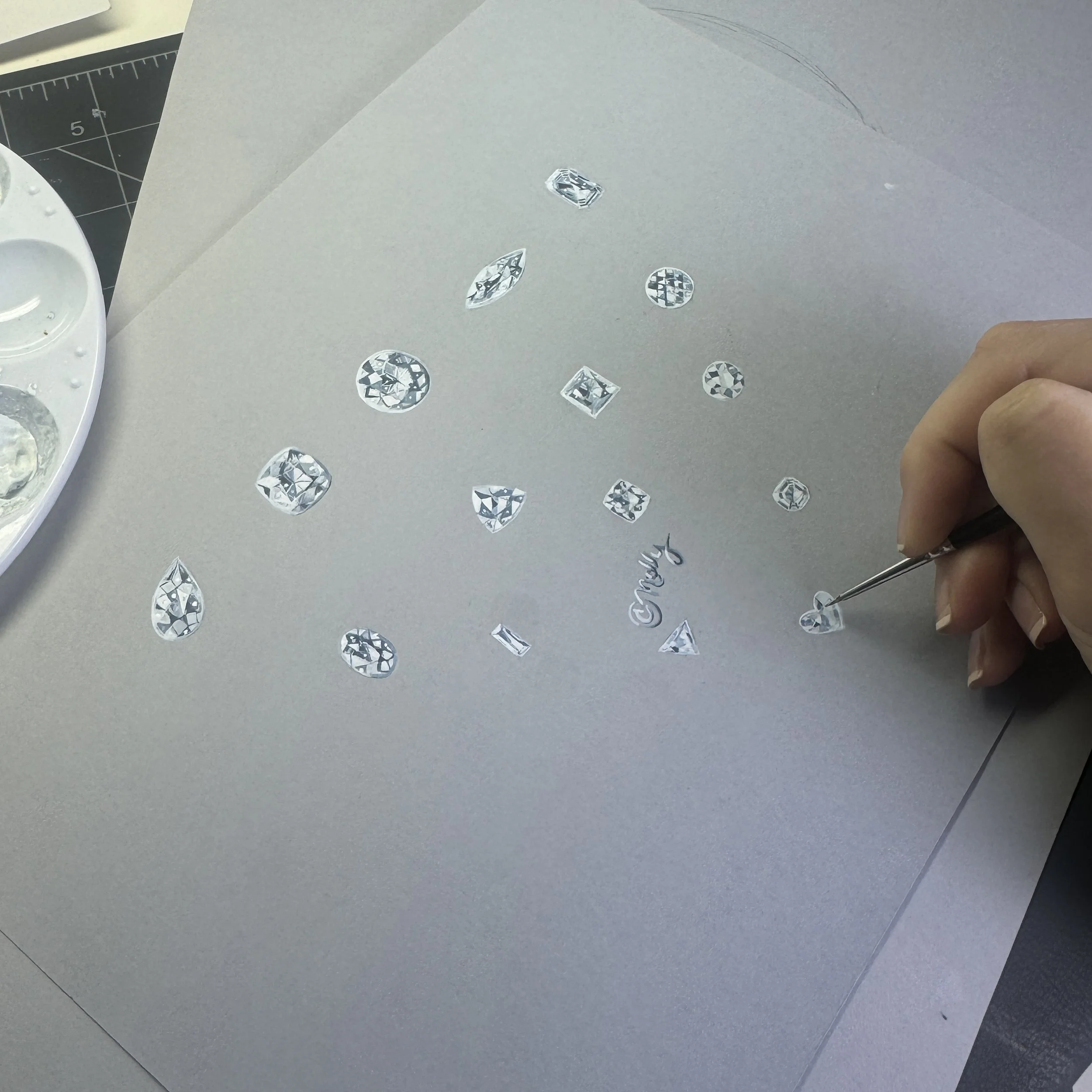
A rendering of different stone cuts by Nelly c 2026
